Tampilkan postingan dengan label Science Fiction. Tampilkan semua postingan
Rabu, 07 Agustus 2013
Peter Capaldi is the new "Doctor Who"
I cannot say that I have ever been a fan of the television series Doctor Who, but I am tempted to start watching since the announcement was made that the sublime Peter Capaldi will take over the beloved and iconic role. Capaldi's work on the British television series Skins, as Sid's father, Mark Jenkins, was award worthy. He also delivered excellent work in Torchwood: Children of Earth and in the 2009 feature film In the Loop. Most recently, Peter Capaldi played a doctor working at the WHO (World Health Organization) in the hit movie World War Z (and I made a joke about Doctor Who in that review, which you can read here). Congratulations to Peter Capaldi for landing such a great role!
Senin, 22 Juli 2013
"Star Trek FAQ 2.0: Everything Left To Know About The Next Generation, The Movies and Beyond" by Mark Clark
Author Mark Clark may want to consider an ongoing series of Star Trek FAQ books. Even after two efforts loaded with information about the Star Trek franchise, he could easily fill a third volume just by focusing on the television series Deep Space Nine, Voyager and Enterprise. A fourth volume could tackle the numerous comic book series that have been inspired by the various television shows and, of course, there is a new feature film franchise from J.J. Abrams to examine. I am not sure the author is considering such projects and it appears that he may be done compiling Star Trek books, at least that is the impression I was given while reading Star Trek FAQ 2.0.
The major focus of Star Trek FAQ 2.0 is The Next Generation television series, which ran for seven years and became the most popular program of its time in syndication. Sadly, I was one of those diehard "original series" types who generally refused to watch The Next Generation during its original run, from 1987-1994, but I did start watching reruns in the late 1990s and came to appreciate the considerable effort that was put forth. Mark Clark examines all 178 episodes of The Next Generation in various chapters and also singles out the performances by Patrick Stewart (Jean-Luc Picard), Brent Spiner (Data) and Michael Dorn (Worf), in others. The Next Generation feature films are also examined, as are the ones starring the original cast. While Deep Space Nine, Voyager and Enterprise are all mentioned, they do not receive nearly as much attention. That is not a criticism, just an observation.
The continuity within the Star Trek universe is explored in detail throughout the 400 page book and is one of my favorite aspects of Star Trek FAQ 2.0. I did not realize that so many connections existed between the original Star Trek and The Next Generation, including the frequent guest appearances by Majel Barrett-Roddenberry as Lwaxana Troi in The Next Generation and Michael Dorn's role in Star Trek VI: The Undiscovered Country. I also learned that Jonathan Del Arco, from The Closer and Major Crimes, portrayed Hugh, a Borg, in The Next Generation. I was also pleasantly surprised to learn about the numerous Emmy awards that The Next Generation acquired during its run, despite being overlooked in the Drama Series and various acting categories. One of the most interesting aspects of this effort is the behind the scenes trouble that transpired during the first few seasons of Star Trek: The Next Generation. Creator Gene Roddenberry was at the center of most of those issues and readers come away with the idea that he may have either been very difficult to work with and/or very protective of the Star Trek legacy.
I read with interest about the continuing inclusion of social issues in various Star Trek series and the quest for peace and harmony between different populations throughout the Federation. However, I think Gene Roddenberry may have oversimplified the notion that there should not be any interpersonal conflict between members of the crew on The Next Generation. While it is admirable to suggest that people may be able to coexist more harmoniously in the future, I suspect there will always be at least some internal strife. In addition to the analysis of the films and each episode of The Next Generation, Mark Clark includes a chapter of quotes and another centered around food and beverages that Trekkies will surely enjoy. Overall, Star Trek FAQ 2.0: Everything Left To Know About The Next Generation, The Movies and Beyond (Applause Books) is a fascinating and thoroughly interesting read, as well as a superb follow-up to its predecessor.
Sabtu, 15 Juni 2013
DVD Recommendation: "Dark Skies" Depicts a Calculated Alien Invasion
Dark Skies came and went quickly in movie theaters this past winter and, as a result, I was not sure I even wanted to see the film, which is written and directed by Scott Stewart. I had a chance to catch a screening at a second run theater and was happy I did, since Dark Skies far exceeded my tepid expectations. The film centers around the Barretts, a family of four who are slowly being infiltrated by aliens. At first, Daniel (Josh Hamilton) and Lacy (Keri Russell) suspect an intruder, or perhaps one of their young children, Jesse (Dakota Goyo) or Sam (Kadan Rockett) are to blame, but as time goes by they understand that something malevolent is occurring and seems to be impacting Sam, who speaks of a visitor in his room at night.
After a few strange events, including finding an open entry door in the middle of the night and missing photographs, Lacy and Daniel consult the police, then have an alarm system installed and eventually conduct their own research which suggests that aliens may be blame for their problems. Of course, neither one of them really wants to believe something so fantastic, but they reach out to a local extraterrestrial specialist, Edwin Pollard (J.K. Simmons), for help. Pollard is able to provide crucial, if unsettling, information to the stressed couple. To their credit, Lacy and Daniel entertain the idea of moving, but financial problems make that difficult and what is to prevent the alleged aliens from following them to their next home? The Barretts realize that the problem needs to be addressed directly, so they formulate a plan that they hope will save their family.
In my experience, contemporary horror/sci-fi films struggle with delivering any real surprises or genuine scares, but Dark Skies does both. Indeed, director Scott Stewart builds a suspenseful, edge of your seat atmosphere throughout most of the film. Even when the antagonists are identified, the film steams forward and does not miss a beat. In addition, the performances are better than I expected and even the child actors deliver fine and believable work. The special effects are nothing extraordinary, but that is appropriate in this character driven and suspenseful gem that deserves to find an audience now that it is available on DVD.
Rabu, 12 Juni 2013
Giveaway! Win A Copy of "Star Trek FAQ 2.0" by Mark Clark
Updated 06/24/2013 - The giveaway has ended. Congratulations to Dayna P. from Central, SC and Nancy R. from Wake Forest, NC
PopCultureGuy, in conjunction with Hal Leonard Books and Applause Books, would like to give two lucky readers an opportunity to win the new book Star Trek FAQ 2.0: Everything Left to Know About the Next Generation, the Movies, and Beyond by Mark Clark.
Description: As J.J. Abrams’ sequel Star Trek film launches into the cinema this spring, Mark Clark sets off to create the final frontier of Trek scholarship in the follow-up to his highly praised book, Star Trek FAQ.
Star Trek FAQ 2.0 (Applause Books) picks up where Star Trek FAQ left off, chronicling the historic comeback of the “failed” series and its emergence as a pop culture touchstone. While the first book covered only the 79 episodes of the classic Trek program, this volume covers all eleven feature films, 176 episodes of Star Trek: The Next Generation, and overviews of the spin-off series, Deep Space Nine, Voyager, and Enterprise. It also offers profiles of the actors, directors, writers, producers, and technicians whose excellence fueled the franchise’s success. This book explores often-overlooked aspects of the Star Trek phenomenon, such as unofficial, fan-made productions. And what FAQ would be complete without quirky chapters like “The Foods and Beverages of Star Trek,” “Patrick Stewart’s Finest Moments,” and “The Quotable Next Generation”?
Star Trek FAQ 2.0 is an enjoyable voyage through the franchise that once struggled to survive from one season to the next but has become immortal.
To enter the giveaway, send an e-mail to don.sauer@gmail.com, place "Star Trek" in the subject line and tell me the name of your favorite Star Trek television series. The contest begins June 12, 2013 and runs through June 19, 2013. Two winners will then be drawn at random and notified shortly thereafter and will need to provide a shipping address at that time.
Open to residents of the U.S., 18 years of age or older.
Good luck and thank you for reading PopCultureGuy!
Visit Hal Leonard Books here.
Sabtu, 01 Juni 2013
"After Earth"- Starring Will and Jaden Smith
Will Smith's character's name in the just released film After Earth is Cypher Raige. I know, it is groan inducing. I would have gone with sourpuss (see photo above) or drone, since that is how he speaks throughout much of the film. Granted, he is injured, but that is no excuse for being annoying. Cypher is a high ranking official in the Ranger Corps (Ranger Smith, if you will) and a tough, yet loving father to young Kitai, portrayed by Smith's son Jaden, who takes over the lead role from his dad as the film moves along.
Set in 2025, After Earth centers around a mission to transport a dangerous beast to a location where it cannot harm others. As you might expect, trouble causes the ship to crash land and the predator escapes. It is up to the badly wounded Cypher to guide his inexperienced son around the planet, which happens to be an inhospitable and deserted Earth, where it is tough to breathe and even more difficult to survive the numerous dangerous species that now roam the planet. Kitai is literally on his own, as Cypher communicates with him from the wreckage of the vessel, while the youngster sets out to transmit a signal for help, which can only be done from a specific location.
Kitai's journey tests the young man and is like nothing he has ever experienced before. He wants to impress his father and successfully complete the mission, but he must battle large birds, a group of very angry apes, extreme weather, and the large predator that escaped when the ship crash landed. The beast is also responsible for the loss of someone close to Kitai and Cypher, which makes their eventual confrontation very emotional.
Director and co-writer M. Night Shyamalan has been looking for a hit for some time now and, sad to say, I doubt After Earth will have mass appeal. Yes, younger moviegoers will likely enjoy seeing Kitai perform impossible feats with little training or maturity, but I am not sure if older viewers will be as patient. Jaden Smith, like Kitai, still needs experience, but he tries hard and is physically impressive as the determined youngster. However, his sudden transformation during the final battle was a bit of a stretch.
Overall, the special effects are decent and the mood of the film is appropriately lonely and foreboding. In addition, After Earth managed to hold my attention during the action sequences on Earth, but I could not get past Will Smith's monotone delivery that is beyond irritating and could be heard while Kitai was moving about. In the past, M. Night Shyamalan has crafted some fine films, such as Signs and The Sixth Sense, and I suspect he will come up with another winner if he keeps trying, but After Earth is simply not one of his better efforts.
Sabtu, 18 Mei 2013
Movie Recommendation: "Star Trek Into Darkness" Moves at Warp Speed
J.J. Abrams' 2009 Star Trek endeavor is my favorite film of the franchise and his follow-up, the just released Star Trek Into Darkness, is probably my third favorite, with Star Trek II: The Wrath of Khan firmly positioned in second place. Abrams has once again constructed a fast paced and extremely entertaining film that pays proper homage to the Star Trek legacy, while allowing every one of the principal cast members to play an important role in the outcome of the exciting adventure. Yes, Kirk (Chris Pine) and Spock (Zachary Quinto) receive more screen time than the others, but this is truly a team effort.
Star Trek Into Darkness begins with Kirk once again breaking the rules, but with the intention of saving his first officer, so that makes it OK. Right? Starfleet does not quite see it that way, so Kirk is relegated to first officer under the command of the newly reinstated Admiral Pike (Bruce Greenwood) on the Enterprise, while Spock is assigned to another ship. However, after a secret installation is attacked, key members of Starfleet are gathered to determine how to proceed, since the person responsible for the heinous act is one of their own, John Harrison (Benedict Cumberbatch), who also goes by the name of....well...just go see the movie. Harrison planned the explosion, in part, to gather many high ranking officers together so he could attack them, but is not entirely successful in his mission and is thwarted by Kirk, at least temporarily.
Following the attack, Kirk asks Admiral Marcus (Peter Weller) for permission to reassume his position as captain of the Enterprise, and is soon back in the saddle with most of his crew intact. Their mission is to find Harrison, who used advanced technology to transport himself to Kronos, a deserted planet within the Klingon Empire. Kirk is ordered to travel to the edge of the Neutral Zone and then fire numerous photon torpedoes at Kronos, thus dispatching Harrison. However, Kirk just cannot bring himself to do as he is told, which results in the Enterprise breaching the Klingon Empire and, perhaps, starting a war that appears to be ready to erupt anyway. Kirk's personal mission is to find Harrison and bring him back to Earth to answer for his crimes, but things do not go smoothly. Kirk and his crew not only face significant danger from Harrison, but also from members of Starfleet, making their mission even more difficult.
In addition to the principal story, Spock and Uhura (Zoe Saldana) are experiencing problems in their relationship, which results in much needed comic relief, while McCoy (Karl Urban) experiments on a Tribble and assists the newly arrived Carol Marcus (Alice Eve) with gathering information about the numerous torpedoes, which Scotty (Simon Pegg) refused to house on board the Enterprise and brought about his resignation. However, Scotty is not off screen for long, thanks to his curiosity following a call from Kirk. With the chief engineer away, Kirk assigns Chekov (Anton Yelchin) to that position, while Sulu (John Cho) is assigned the Conn for the first time while Kirk is away. Indeed, everyone has a important role to play in this space opera.
Abrams, along with writers Roberto Orci, Alex Kurtzman and Damon Lidelof, clearly understand the Star Trek legacy and incorporate many references from the original series, including Carol's mention of Christine Chapel/Nurse Chapel, as well as the aforementioned Tribbles, Klingons and the reintroduction of Carol Marcus, who was Kirk's love interest in early Star Trek films. Did I mention one of the original cast members makes an appearance, too? In addition, the interpersonal relationships among the crew members are familiar and appreciated, including the bickering between McCoy and Spock. Kirk's legendary libido is acknowledged on more than one occasion, too.
The performances are generally solid, as the actors are becoming more comfortable in their respective roles. Simon Pegg is especially good as Scotty, and Benedict Cumberbatch delivers a chilling performance as John Harrison/the villain. Peter Weller is also well cast as the complicated Admiral Marcus. The two plus hour run time flies by with Abrams' deft direction of the talented cast, who put their own spin on the legendary characters created by the late Gene Roddenberry. Overall, Star Trek Into Darkness is an outstanding effort. More, please!
Selasa, 05 Maret 2013
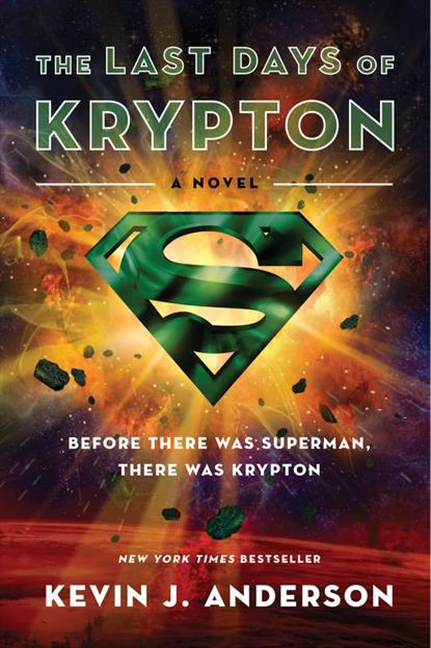
Paperback Spotlight: "The Last Days of Krypton" by Kevin J. Anderson
Before Kal-El was born, major problems plagued his home planet of Krypton, including poor leadership, a brutal dictator and vast environmental problems that would lead to its untimely demise. Those are not spoilers, or at least they should not be for anyone familiar with the legacy of the future Superman, who was placed in a tiny spaceship by his parents, Jor-El and Lara, and sent towards Earth as Krypton was about to explode. The story of the eventual demise of that well known fictional planet is depicted in Kevin J. Anderson's The Last Days of Krypton. The book, which was originally released in 2007, is now available in paperback from It Books.
This epic sized effort is extremely detailed, verbose and features a very large cast of characters. The author provides a list of those characters and a short description of each, which is helpful to refer to while reading. However, readers only need to be completely aware of the half dozen major players; Jor-El, Lara, Zor-El, Zod, Aethyr-Ka (Zod's love interest) and Nam-Ek (Zod's loyal friend), who all play significant roles throughout the book. There are several storylines that drive the prose, including Zor-El's (Jor-El's brother) discovery of problems within the planet's core, the ineffective leadership of the leaders of Krypton, the destruction of the city of Kandor by an alien entity, the emergence of Zod, who takes control after an alien attack and rules like a savage dictator, the romance between Jor-El and Lara, and Jor-El's scientific achievements, which could possibly save the seemingly doomed planet. Yes, that is a lot of ground to cover, but the 400 plus pages allow it all to be told.
Readers familiar with the Superman legacy will recognize several iconic references, including the origin of the "S" logo, Brainiac, the emergence of a green mineral which will become known as Kryptonite, the Phantom Zone, and an unexpected appearance by the Martian Manhunter. I was particularly interested in learning more about Zod, who is portrayed as a super villain who will go to any lengths to have his way. In addition, I could not help but think of our own world in regards to planetary changes and dangerous, out of touch leaders who take too much time in making important decisions about matters that deserve expediency.
Kevin J. Anderson should be credited with crafting such an epic story and paying close attention to detail throughout. However, I found myself becoming distracted from time to time at the endless number of characters, most of whom add nothing significant or memorable to the story. The principal players are well written and considered, but I had hoped Lara would play a larger role than she did. Zod, Jor-El and even Zor-El are featured prominently throughout, while Lara is almost relegated to supporting status, at least for a while.
The fate of Krypton is a forgone conclusion, but the various threats posed to the planet throughout the book are sometimes unexpected and add to the considerable amount of suspense that culminates in the exciting last few chapters, which offer some closure, while other outcomes are left open-ended, as they should be. Overall, The Last Days of Krypton is a worthwhile effort that fanboys will appreciate for its consistency with the Superman mythology and science fiction aficionados will appreciate for its vivid descriptions of another world and the various alien entities who visit Krypton, for better or for worse.
Selasa, 22 Januari 2013
Sci-Fi Spotlight: "The Martian War" by Kevin J. Anderson
A gathering of real and imagined extraordinary gentlemen (dare I say league) and one woman populate the re-release of The Martian War (Titan Books) by Kevin J. Anderson. Author H.G. Wells, biologist T.H. Huxley, astronomer Percival Lowell, Dr. Moreau, Hawley Griffin (The Invisible Man) and Wells' fiance Jane all play pivotal roles in the story, which centers around a potential Martian invasion of Earth. Wells, along with his mentor, Huxley, and Jane find themselves in the far reaches of space, after an accident that nearly costs them their lives. They are able to return to Earth at their leisure, but they decide to explore the moon and then Mars, which leads to many disturbing discoveries that places them all in danger yet again. Meanwhile, Dr. Moreau, who approached Wells and Huxley about a potential alien invasion before the accident, recounts a personal story about his encounter with a spaceship and a Martian. Moreau, along with Percival Lowell, struggle to learn as much as they can from their extraterrestrial find in order to prepare for and/or prevent an invasion.
The author assembles an interesting cast of characters who mesh together well, even though they probably should not. As I was reading, I found it strange that I was partial to the narrative when it focuses on Dr. Moreau's journal than the exploits of Wells, Jane and Huxely in space. Both storylines are interesting and well written, but it was almost like two different authors took turns writing the story. Credit should be given to Anderson, who is clearly trying to channel the real life H.G. Wells and the fictional Dr. Moreau, who are two very different people, and succeeds in relating their unique points of view.
Of course, it was Wells who wrote The War of the Worlds and The Martian War speculates that Wells may have been writing a true story based on his personal experiences. While some may find that far fetched, the famous 1938 radio broadcast of "The War of the Worlds," which was initiated by screen legend Orson Welles, convinced some listeners that the invasion was actually real. Yes, even in the late nineteenth and the early part of the twentieth century, some people wanted to, or were at least inclined, to believe in extraterrestrials. I am not sure if The Martian War is likely to change anyone's mind about the origins of The War of the Worlds, but science fiction fans will have an enjoyable time judging for themselves.
Sabtu, 29 September 2012
Joseph Gordon-Levitt Stars in Rian Johnson's "Looper" (2012)
Photo Credit: Tri-Star Pictures
Rian Johnson's Brick (2005) is one of my all-time favorite movies and pushed star Joseph Gordon-Levitt onto the short list of my favorite actors, where he has remained ever since. Their latest collaboration, Looper, is a sci-fi film involving time travel that is a somewhat disappointing. Gordon-Levitt portrays Joe Simmons, as assassin who works for an organized crime syndicate in the year 2044. Joe is a "looper," who kills agents who are sent back through time, from 2072, by his employers. When the agents arrive, they are usually on their knees, with a bag over their head, so the "loopers" cannot see their targets when they shoot them and subsequently "close the loop." However, one of Joe's assignments goes wrong, as the man who has been sent back is actually an older version of himself. The older Joe is portrayed by Bruce Willis and when he arrives, there is no bag around his head. When Joe recognizes his older self, he freezes, allowing just enough time for Old Joe to escape. The botched job brings the heat on Joe from his employers, who are intent on hunting him down and disposing of him, as failure means death in their business.
The leader of the "loopers" is Abe (Jeff Daniels), who orders both Joes to be eliminated, but that proves difficult. The older Joe has experience on his side and the younger Joe is very good at his job. Even though they are at odds, the Joes have an undeniable connection and they eventually meet to discuss their plans. During the meeting, Old Joe reveals his back story and declares his intention of killing the so-called "rainmaker," who was responsible for the death of his beloved wife in the future. Old Joe is intent on tracking him down and killing him, so that his wife can be spared. Since the "rainmaker" is now a young child, eliminating him should not be a problem. Their brief time together is interrupted by Abe's men, but both Joes manage to escape. Young Joe, who plans to stop his older counterpart, holes up in a corn field opposite a farm where a young woman, Sara, is living with a young child, Cid (Pierce Gagnon). Sara eventually spots Joe and orders him to leave, but he implores her to let him stay there because he needs to evade Abe's men. Of course, a romance soon develops between them, but they have little time to enjoy each other's company, as they are on a collision course with Old Joe and Abe's men.
Rian Johnson's screenplay is very creative, but his direction, especially during the first half of the film, feels disjointed. It takes a good hour for Looper to come together, but once it does, the film finds its groove and the second half is consistently good. Johnson has assembled a very talented cast and the aforementioned Gordon-Levitt, Willis, Blunt and Daniels deliver fine performances. However, I wish Daniels would have been given more to do, instead of being confined to headquarters, away from most of the action. In addition, I know the idea is for Gordon-Levitt to look like a younger version of Bruce Willis, but the make-up looks silly. I appreciate the attempt at realism, especially in a sci-fi effort that encourages you to suspend your disbelief, but the make-up is just not necessary.
The pairing of Sara and Young Joe helps to anchor the second half, which offers a few surprises and supplies answers to some questions, such as what happens to a "looper" when a version of himself is eliminated. In addition, the psychological implications for Old Joe, as he prepares to kill children who may be the "rainmaker," takes a toll that is perfectly conveyed by Willis. The special effects featured throughout the film are also quite good. However, Looper lacks consistency and I found myself squirming in my seat during the first half of the film, which is all over the place. Yes, it does settle down, but I suppose my expectations may have been too high. As a result, I cannot fully recommend Looper, but from what I understand, I am in the minority.
Rabu, 19 September 2012
Coming Soon: The Science Fiction Universe and Beyond: Syfy Channel Book of Sci-Fi
The science fiction genre has spawned countless feature films and television series over the past several decades. In fact, if you include Georges Méliès's A Trip to the Moon, the genre first began more than a century ago, in 1902, in film. Méliès's A Trip to the Moon, which inspired Martin Scorsese's 2011 film Hugo, is featured in the upcoming book, The Science Fiction Universe and Beyond: Syfy Channel Book of Sci-Fi (Universe), by Michael Mallory, along with numerous other Sci-Fi related projects that have forever changed popular culture. This effort is not a complete history of the genre, but focuses on those movies and television series that helped to shape the medium and have had the largest impact.
For instance, specific series and films are spotlighted at the end of every chapter, including Star Trek, The Twilight Zone, Star Wars and The Planet of the Apes, among others. Of course, some of the additions and omissions will be debated passionately by fans of the genre, who have different definitions of science fiction. To the author's credit, he lists an additional 100 films and television series that were not featured in the book, including Space 1999, The Jetsons, Galaxy Quest and Voyage to the Bottom of the Sea, but are worth noting, nonetheless.
I suspect that any science fiction fan will enjoy The Science Fiction Universe and Beyond: Syfy Channel Book of Sci-Fi. The coffee table book features countless full color photographs from beginning to end, from Fritz Lang's 1927 classic Metropolis to the Syfy's channel's current hit series Alphas. While it is difficult to argue with most of the film and television choices included here, I think The X-Files, which is featured, should have been given more attention, considering the impact and ongoing influence of the Emmy winning series on other television shows, such as Fringe and the recently cancelled Alcatraz. On the other hand, I was pleased to see the attention paid to The Planet of the Apes franchise, which continues to be popular, almost a half century after its debut. The success of the recent hit film, Rise of the Planet of the Apes, and the current ongoing comic book series from Boom!, is proof the franchise is still going strong.
Superheroes are also mentioned throughout the book, which focuses on the television series The Adventures of Superman, The Incredible Hulk, Wonder Woman and The Six Million Dollar Man, more so than the recent glut of incredibly popular films, such as The Avengers and Iron Man. One thing is for sure, the advances in technology and special effects have helped the superhero genre take over the multiplexes, at least during the summer movie season. Of course, they have been a staple on television as well, with The CW's decade long run of Smallville and NBC's Heroes.
One of the most interesting aspects of The Science Fiction Universe and Beyond: Syfy Channel Book of Sci-Fi is that Star Trek seems to receive more attention than Star Wars, which is sure to have fans of both franchises talking. To be honest, I am partial to Star Trek, but certainly appreciate the legacy of Star Wars and its amazing contribution to the film world. While Sci-Fi is still very popular in feature films, the genre thrives on television too, thanks, in part, to the Syfy network, which has produced a number of hit series and made for television films over the past two decades. The latter part of the book places a strong focus on the programs on Syfy, as well as several Star Trek spin-off series.
The Science Fiction Universe and Beyond: Syfy Channel Book of Sci-Fi features over 250 pages of the best in science fiction from the last century of film and the last six decades of television, in chronological order (except for the Spotlight features), and will be available on September 25.